

Environmental Simulations Facility
Location:
This facility is operated under the supervision of
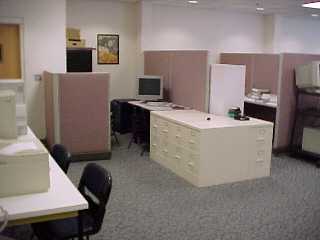
Dr. Guan and is located on the second floor of the Sustainable
Education Building (SEB - Room 215), Georgia Institute of
Technology. SEB is located on Atlantic Dr., across the School of
Civil and Environmental Engineering building, known otherwise as the
Mason Building.
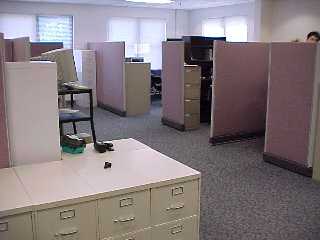
The space in this
laboratory is used to house eight Ph.D. students. In addition to
this space, a research engineer and faculty member, affiliated with
MESL and the Environmental Engineering program, has office space in
the SEB building.
Computational Facilities:
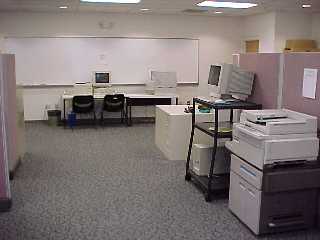
Twenty 900MgHz high end IBM/PC compatible workstations and desk top
computers. Two UNIX based high end Indigo Impact R10000 SGI
workstations. One SGI Origin 2000, R10000 super computer. These
networked computational facilities are dedicated to modeling
activities of MESL personnel. Other than these equipment, the
computational laboratory has several scanners, high end black and
white / color printers and digitizers.
Software: The MESL
productivity software library include most recent versions of GIS
ARC/INFO, GIS ARC/VIEW, GISPlus, EVS, ENVI, NAMMU, AUTO CAD,
Fortran, C++, Visual C++, Visual J++, Visual Basic compiler
software. Simulation software available to MESL researchers include
ACTS, SAINTS, SLAM, ULAM, CLAM, RiverNET, PGA, OPTIM/PT, SOURCE,
which are all developed by MESL researchers. In addition to these
software, MESL researchers have access to numerous multi-pathway
simulation software packages such as MODFLOW, MODPATH, SUTRA,
CHEMFLO etc., which are in the public domain. MESL is housed in the
School of Civil and Environmental Engineering, Georgia Institute of
Technology.
Environmental Physico-chemical Process Facility
This facility is operated under
the supervision of Dr. Huang and Dr. Kim. It occupies more than 1700
ft2 space in the Environmental Science & Technology building, and is
equipped with a range of instruments to support several on-going
research projects.
Dr. Huang's environmental
chemistry laboratory currently contains a range of instrument and
experimental apparatus including an Agilent 1100 high performance
liquid chromatography (HPLC) system with an autosampler, a
diode-array UV/Visible detector and a fluorescence detector, an
Agilent 6890/5973 gas chromatography-mass spectrometry (GC/MS)
system with an autosampler, two injector ports, an electron-captured
detector (ECD), a flame ionization detector (FID) and a
nitrogen-phosphorus detector (NPD), a Biotek EL-800 microplate
reader, and a Hewlett-Packard UV/Visible spectrophotometer. Other
equipment includes a solid-phase extraction apparatus, a
microbalance, an Eppendorf microcentrifuge, a refrigerator,
multiple-stirrers with a bath circulator, a shaker and an incubator.
In addition, a high performance liquid chromatography-mass
spectrometry (LC/UV/MS) system (1100/Series 100 MSD G1946A,
Hewlett-Packard) with both electrospray ionization (ESI) and
atmospheric-pressure chemical ionization (APCI) interfaces and a gas
chromatography-ion trap mass spectrometry systems (Saturn 2000,
Varian) capable of tandem MS capability (GC/MS/MS) at both
electron-impact ionization and chemical ionization options are also
available for organic analysis. Excellent analytical capability also
exists for inorganic analysis. The instruments include an
inductively-coupled-plasma trace analyzer, an inductively coupled
plasma/mass spectrometer (ICP/MS), a graphite-furnace atomic
absorption spectrometer and a flame atomic absorption spectrometer.
Several walk-in temperature-controlled rooms at 4 C, 22 C, and 35 C
are also available.
Dr. Kim's physicochemical process
laboratory is currently equipped with a range of instruments and
experimental apparatus. Analytical instrumentation includes: an
Agilent 1100 high-performance liquid chromatography system with
autosampler and a diode array UV/VIS detector, a Dionex DX-600 ion
chromatography system with autosampler and electrochemical detector,
an Agilent 8453 UV/VIS spectroscopy system, a Brookhaven ZetaPlus
zeta potential analyzer, a Brookhaven Laser Light Scattering System
(BI-200SM Goniometer and BI-9000 Autocorrelator) equipped with a
488-nm argon laser Model 543 (Omnichrome), Brinkmann 2010 particle
size analyzer, Shimadzu UVw TOC analyzer, Hach 2100N Turbidimeter,
microbalance, and pH/conductivity/ion analyzer. Other equipment
includes: Sterlitech high pressure dead-end filtration unit, an
Osmonics high pressure cross-flow filtration setup, jar-tester,
Milli-Q water purification system, and temperature controllers.
The Environmental Physico-chemical
Process Laboratory is located on the 3rd floor of the ES&T building
at Georgia Tech.
Environmental Biotechnology and
Molecular Microbial Ecology Facility
This facility is operated under
the supervision of Dr. Pavlostathis and Dr. Sobecky and is equipped
with a range of instruments to support several on-going research
projects:
Dr. Pavlostathis' environmental
biotechnology laboratory contains a full range of general equipment,
glassware, plasticware, and supplies typically found in an
environmental biotechnology laboratory, as well as the following
instruments: one purge-and-trap concentrator; five gas
chromatography units with electron capture, flame ionization,
thermal conductivity, flame photometric, photoionization, and
electrolytic conductivity detectors; two high performance liquid
chromatographs with continuous UV, diode array, refractive index and
fluorescent detectors; one ion chromatograph with conductivity and
electrochemical detectors; one total organic carbon analyzer (for
liquid and solid samples); one polarographic and anodic stripping
voltammeter; one UV-visible/diode array spectrophotometer; one
research light microscope (phase-contrast, normal light and
epifluorescence); a nitrogen digestion and ammonia distillation
unit; and a transducer-based sonolysis unit.
In addition, the Environmental
Engineering Laboratory located on the 3rd floor of the ES&T building
is equipped with the following instruments: three GC/MS/DS systems;
one LC-MS unit; one purge-and-trap concentrator; ten gas
chromatography units with electron capture, flame ionization,
thermal conductivity, and flame photometric detectors, as well as a
reduction gas analyzer; four high performance liquid chromatographs
with continuous UV, diode array, refractive index and fluorescent
detectors; one micellar capillary electrophoresis unit; two ion
chromatographs with conductivity and electrochemical detectors; one
total organic carbon analyzer (for liquid samples); one surface area
(BET) analyzer; one mercury porosimeter; one total oxygen demand
analyzer; flame and flameless atomic absorption spectrophotometers;
one inductively coupled plasma-mass spectrometer (ICP-MS); one
liquid scintillation counter; specific ion analytical equipment;
three UV-visible spectrophotometers; infra-red spectrophotometer;
submicron and supramicron particle size analyzers; micro-electrophoretic
mobility instruments. Arrangements can also be made with other
departments for access to advanced equipment such as high resolution
mass spectrometers (e.g., LC-MS-MS), scanning electron microscopes,
FTNMR spectrometers, and neutron activation analytical
instrumentation.
The environmental biotechnology
laboratory is located on the 3rd floor of the ES&T building at
Georgia Tech and occupies a floor space of 1,200 sq. ft.
Dr. Sobecky's molecular microbial
ecology laboratory is equipped with the standard tools and equipment
to conduct molecular microbial ecology studies. These include
horizontal and vertical gel rigs and power supplies, electroporator,
denaturing gradient gel electrophoresis (DGGE) system, hybridization
oven and gene probing equipment, DNA thermal cyclers, and a
Stratagene gel documentation system. Sequencing facilities are
available in the School of Biology Core Sequencing Facility located
in the Cherry Emerson building.
The molecular microbial ecology
laboratory includes the following equipment: microcentrifuges,
incubators, incubator shakers, low and ultra-low refrigerators, UV-VIS
spectrophotometer, Beckman and Sorvall high-speed centrifuges,
ultra-centrifuge and rotors, Olympus epi-fluorescence microscope
with CCD imaging system, water baths, refrigerators, pH Meter and
balances. Several Macintosh and PC computers are also available with
network capabilities. Equipment available for shared use in the
School of Biology includes an Ambis Image Analyzer, x-ray film
developer, autoclaves, scintillation counter, Speed Vac concentrator
systems and water purification systems. Additional equipment
available in the Institute of Bioscience and Bioengineering (IBB)
located next to the School of Biology include a laser scanning
confocal microscope. Shared facilities in the School of Biology and
the Institute of Bioscience and Bioengineering include a Coy
anaerobic chamber, confocal laser and scanning electron microscopy.
Dr. Sobecky's research group is
located on the 2nd floor of the ES&T building at Georgia Tech and
occupies a floor space of 1,000 sq. ft. In addition, Dr. Sobecky has
acquired another 1,000 ft2 in ES&T to establish a "microbial omics"
facility, that will be a core facility for real-time PCR, DNA
microarray analyses, HPLC and CE systems.
|